View all
Web DevelopmentMobile Development UX/UI DesignStaff Augmentation CTO as a ServiceDedicated TeamLow-Code DevelopmentHow to Outsource Mobile App Development Without Getting Burned
Client Guides

Aug. 04, 2026
16:00 min to read
-1785852681134.webp)
Table of Contents
Should You Outsource Mobile App Development At All?
Engagement Models
7 Red Flags When Choosing an Outsourcing Partner
How to Choose the Right Outsourcing Partner
Where to Outsource
What Does It Really Cost?
The First 90 Days
Common Outsourcing Risks
What's Changed in 2026
Outsourcing mobile app development needs a rigorous validation process if your goal is to successfully launch it on the market, and not just invest money in development. This guide focuses on choosing an outsourcing partner rather than merely discussing the benefits of globalization. We'll tell you how to avoid wasting your budget on scope creep, protect your intellectual property (IP), and survive the first 90 days of development without stress and budget shocks.
Let's start with an unpleasant truth. A significant portion of startups have suffered at least once due to outsourcing development. The typical stories we hear from clients who outsource app development but later come to us to "rescue" a project sound similar. For example, the vendor simply stopped communicating. The budget doubled due to constant scope creep. The code turned out to be of such low quality that it was cheaper to rewrite it from scratch than to maintain it.
Such unfortunate experiences are among the reasons large companies are returning to the idea of strengthening in-house teams rather than outsourcing application development. According to a Deloitte survey, 70% of organizations have insourced portions of previously outsourced work in recent years. Among the reasons cited by business and technology executives are the desire to improve service quality and minimize vendor markups.
However, this strategy is not suitable for small and medium-sized businesses, as maintaining an in-house team with a full complement of mobile development specialists is quite expensive. That's why we've prepared this tactical playbook for CEOs and CTOs based on our experience working with over 100 projects. You'll learn how to properly outsource mobile app development in 2026, paying attention to red flags signaling against making a deal.
Should You Outsource Mobile App Development At All?
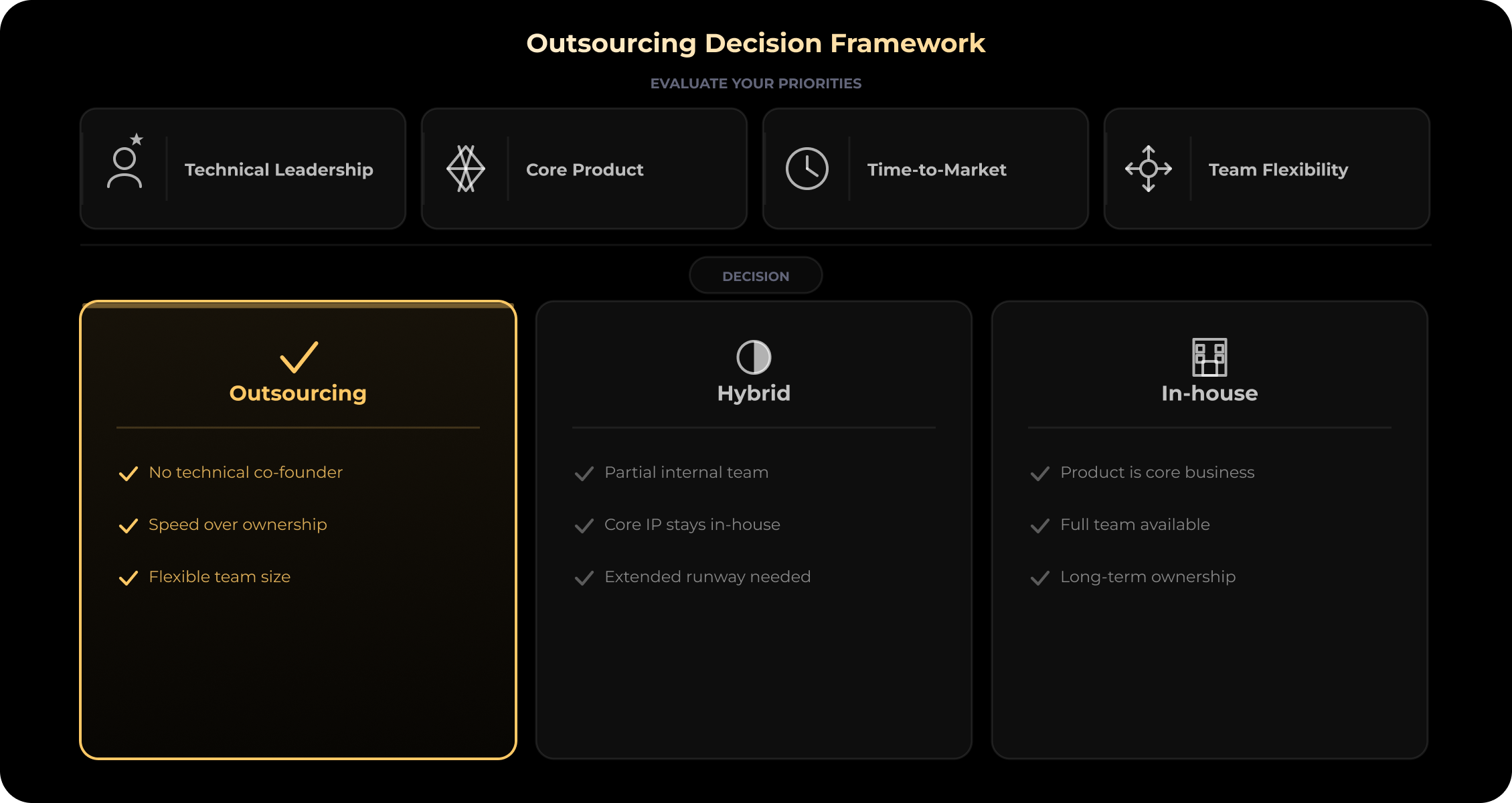
Before discussing how to outsource app development, let's honestly answer the question of whether this strategy is right for you. Outsourcing isn't a one-size-fits-all solution that will help a business achieve its goals in every situation. So, here's a 5-question framework to help you make your decision:
- Do you have in-house technical expertise? If you don't have a CTO or a strong tech lead who can validate the vendor's architectural decisions and code quality, you're taking on a huge risk. An outsourcing team needs a qualified client to control its work. If you don't have an in-house leader, you will need a CTO-as-a-Service to oversee the process of development.
- Is a mobile app your core product? If your app is your entire business, outsourcing development entirely to an external agency carries risks for investor valuation. For example, this situation might arise if you're planning to launch a neobank or a complex AI startup. In this case, it's better to build an in-house team or use a hybrid model. The situation is entirely different if your app is a supporting product. For example, it could be a companion app for a hardware device or an e-commerce storefront. In this case, outsourcing is a rational choice.
- Are there strict budget constraints on local hiring? Let's do the math. Maintaining an in-house senior developer in the US or Western Europe will cost $150,000+ per year, excluding taxes and benefits. If your turnaround time is limited, outsourcing allows you to access the same level of talent in Eastern Europe or LatAm at a much lower cost.
- How much time-to-market pressure do you have? Hiring, onboarding, and coordinating an in-house team takes 3 to 6 months. A ready-made outsourced team can start working on your project within 1–2 weeks. If you're under pressure from investor deadlines, speed is key to success.
- What are your long-term plans for your software development team? Do you need to scale your team up and down depending on funding rounds? Outsourcing provides flexibility. Firing in-house employees is time-consuming, expensive, and toxic to company culture. Therefore, if you do not have enough work to keep your in-house team busy, it will be better to outsource mobile app development.
Based on your answers, we can tell you when you should not outsource mobile app development. Don't outsource if you need permanent collaboration in your office; if you don't have someone for technical oversight, or if the app is a secret core of your early-stage business, but the patents have not been filed yet. In all other cases, outsourcing should be considered a viable alternative.
Engagement Models: Freelance, Agency, or Dedicated Team
If you've decided that outsourcing is the right path, the next step is choosing an engagement model. The wrong model guarantees a conflict of expectations. You will expect certain results and behavior patterns from a mobile app outsourcing company, but they'll follow standard industry practices. Therefore, you should understand how a dedicated team model differs from staff augmentation or freelance work. So, here's an honest look at the available options:
| Model | Price Range | Best Suited for | Risk Level | Communication | Level of Control |
| Freelance | Low ($) | Simple features, proof-of-concept, bug fixing | High Risk of specialist disappearance and problems with the code | Asynchronous | Complete, but requires micromanagement |
| Agency (Project-Based) | High ($$$) | Turnkey projects when you don't have your own PM or clear processes | Low The agency assumes responsibility for the risks associated with delivery | Through the agency's PM | Low You control the outcome, not the process. |
| Dedicated Team | Medium ($$) | Long-term projects, post-Seed round startups, and MVP development | Medium The main risk is the cost of downtime if you have an empty backlog and the need for strong in-house product management | Directly with the team | High The team operates as your in-house team |
| Staff Augmentation | Medium ($$) | Scaling an existing in-house team | Low Technical risks are yours | Direct | High |
Don't try to force a cheap model into developing a complex product. If you're building a serious business, not just testing a hypothesis on the fly, you need predictability. Invest in a Dedicated Team or Agency. This will shift your focus from daily code micromanagement to improving metrics and product development. In any case, choose a model based on your available management resources, not just a desire to save money.
Fixed Price vs. Time & Material Contracts
The choice between fixed price vs time and material contracts is a matter of who bears the risk of change.
- A fixed-price model is chosen when the scope of work is documented down to the last detail and the project is short (up to 2-3 months). Still, in reality, the scope is constantly changing when developers deal with startups. That is why, with a fixed-price model, any new idea will require contract revisions. Moreover, the vendor may skimp on quality to stay within the contract's margins.
- Time & Materials (T&M) is the standard for projects with evolving functionality, such as MVPs and long-term development. You pay for actual hours. This provides flexibility as you can change sprint priorities on the fly.
- At Stubbs, we often recommend a hybrid format. The Discovery and Design phase is conducted on a fixed-price basis to define the backlog and architecture. The development is carried out on a T&M basis, with estimates for each sprint. This gives the client budget predictability while maintaining product flexibility.
7 Red Flags When Choosing an Outsourcing Partner
If you visit Reddit, for example, the r/Entrepreneur section, you will find hundreds of threads about failed outsourcing projects. In most of these cases, the disaster could have been predicted even during the first few calls. One potential problem is that businesses simply don't know the red and green flags for choosing a mobile app outsourcing company. In this chapter, we will show 7 critical "red flags" that should immediately end negotiations:
- Refusal to show a portfolio with real client names. If you're only shown anonymous screenshots with a reference to a "strict NDA," the agency is likely exaggerating its experience. A reliable partner always has clients willing to confirm their cooperation.
- Abnormally low rates (approximately $10-$15/hour). Miracles don't happen. In 2026, a qualified senior/middle developer won't cost $15/hour. Such a price means your project will be handed over to juniors under the guise of seniors in accordance with a bait-and-switch strategy. Alternatively, the code will be generated mindlessly, leading to technical debt.
- Inability to interview developers who will participate in your project. You should speak with the engineers who will be writing your code, not just a charismatic sales manager. If you're being sold a faceless "team in a box," it's a huge risk.
- Refusal of a trial period. An agency confident in its processes and code quality isn't afraid to give you a 1-2 week trial period. Refusal means they want to lock you into a contract before you see their real work.
- Vague Intellectual Property (IP) protection terms. If the contract doesn't clearly state that the rights to the code, design, and architecture transfer to you upon payment, you risk being held hostage by the app development partner.
- Generic proposals. If a commercial proposal consists of general phrases about "high quality" and doesn't include an analysis of your app's business logic, the vendor hasn't even bothered to delve into your architecture.
- Lack of verified reviews. Profiles on platforms like Clutch or GoodFirms are a hygienic minimum. The lack of independent reviews is cause for serious concern.
How to Choose the Right Outsourcing Partner: A Checklist
Knowing the red flags is only half the battle. You need a systematic vetting process to achieve success. We recommend the following algorithm for selecting an app development partner:
-1785854796606.png)
- Describe the scope and budget in detail. Before talking to vendors, compile a basic product requirements document (PRD). The more precise your input, the more accurate your estimates. Don't ask for an "app evaluation like Uber". Demand an evaluation of specific user flows.
- Create a shortlist of 3-5 vendors. Look for agencies with proven experience in your market niche. If you need a fintech app, don't hire someone who's spent their entire career building e-commerce. If you want to outsource iOS app development, don’t prioritize those who only have native Android development skills. Review their portfolio for relevant case studies.
- Conduct a technical interview with the Lead Developer. Invite the vendor's tech lead or architect to a call. Ask questions about solving scaling issues, building CI/CD, and managing technical debt.
- Request reference calls with former clients. Ask for contact information from 2-3 clients and ask them questions you want to clarify. One of the main questions should be: "How did the team handle things when something went wrong on the project?"
- Insist on a trial period (1-2 weeks). At Stubbs, we offer a 1-week trial with a full refund. It's the easiest way to verify the fit of the potential outsourcing partner. You need this time not to obtain free code, but to test communication, response speed, and process transparency.
- Ask a lawyer to review the contract. Don’t sign a standard NDA or MSA from a vendor without reading it. Pay attention to clauses regarding IP transfer, dispute resolution jurisdiction, and exit strategy.
We covered the process of selecting an outsourcing company in detail in the article "How to Choose a Web Development Partner." So, if you're ready to begin screening candidates, read it to consider additional nuances of development outsourcing.
Proof of Work: Evaluating Technical Complexity in Portfolios
When evaluating a vendor's portfolio, look not at the UI design, but at the complexity of the engineering problems solved under the hood. Here's an example of what the technical description of real projects looks like in the Stubbs portfolio:
Two-Sided Marketplaces and Split Payments (Flymingo)
The Flymingo project is a two-sided charter flight-booking platform built with React Native, Node.js, and Firebase. The main technical requirements were to develop a custom split-payment system via Stripe (with support for Apple Pay and Google Pay) and an algorithm to dynamically calculate the aircraft's allowable weight based on the declared baggage and the number of passengers. Additionally, Google Maps API integration was implemented for route visualization, and a custom in-app camera module was added for baggage recording at check-in.
FinTech Algorithms and AI Integrations (WhoPays)
As part of developing the WhoPays expense-sharing app using React Native, Node.js, and Next.js, engineers designed a real-time balance-calculation engine that supports over 150 currencies and synchronizes state between the iOS and web versions. The architecture includes two AI modules. One of them is an OCR system for automatically parsing uploaded receipts (extracting line items, amounts, and currencies). The second one is a voice assistant that uses NLP to automatically categorize and distribute expenses among group members.
Cross-Platform Syncing and API Integrations (Diatom)
For the Diatom social event management app, an architecture based on React Native, Node.js, and MongoDB was implemented. The technical scope included two-way calendar integration with time zone conversion processing, parsing and synchronization of contacts from the native phone book, and setting up a transactional notification system via the Twilio API (SMS and Push). The platform logic also includes an algorithm for generating connections and wishlists based on processing user quiz results.
Where to Outsource: Regional Trade-Offs
Choosing a location for offshore mobile app development is a compromise between price, quality, cultural fit, and time zone. In 2026, the market is clearly segmented. Below is a table to help you navigate the current international landscape and find the best region to outsource react native development and other tasks. For a deeper dive into outsourcing in neighboring regions, read our guide to nearshore app development.
| Region | Average rate (2026) | English level | Timezone friendly for (US/EU) | Key risks | Key strengths |
| Eastern Europe (Ukraine, Poland, Romania) | $30 – $60/hour | Medium / High | Ideal for the EU Morning crossing for the US | Geopolitical risks in some countries | Top-tier engineering culture, strong mathematical foundation, ownership mentality |
| Latin America (LatAm) | $40 – $70/hour | Medium / High | Same time zone as the US | Slightly higher rates compared to offshore; different levels of technical expertise | Ideal for US startups (nearshore), cultural proximity |
| South Asia (India, Pakistan) | $15 – $35/hour | Varies (depending on vendor) | Suitable for the EU / Middle East | Different mentalities, risk of quality loss when choosing the cheapest teams | Huge talent pool, minimal cost |
| Southeast Asia (Vietnam, Philippines) | $20 – $40/hour | Medium | Suitable for APAC / Australia | Huge time zone difference compared to the US | Low cost, rapidly growing level of technical expertise |
There's no ideal outsourcing region; trade-offs always exist. If daily synchronous calls during US business hours are critical to you and your budget allows for a slightly higher price, LatAm is your choice. If you're based in Europe and seeking maximum engineering expertise and a strong mathematical foundation, Eastern Europe is a good choice for price/quality. The same is true if you are based in the US and ready to work with an async-first model. Asia may be chosen when processes are fully defined, and the project requires scalability due to a large number of standard tasks.
What Does It Really Cost? Realistic Budget Breakdown
The biggest mistake founders make when calculating outsource app development cost is confusing price with the cost of ownership. Let's look at realistic figures for mobile app development in 2026:
Simple MVP with basic functionality, 1 platform:
- Offshore (South Asia): $20,000 – $60,000
- Nearshore / Eastern Europe: $40,000 – $100,000
Medium App with integrations, custom UI/UX, both platforms via React Native/Flutter:
- Offshore: $60,000 – $150,000
- Nearshore / Eastern Europe: $100,000 – $250,000
Complex App with Real-time data, AI features, complex architecture:
- Offshore: $150,000+
- Nearshore / Eastern Europe: $250,000+
Hidden Costs: What You Will Pay for but Didn't Account for at the Start
An estimate consisting solely of developer hours is an illusion. A realistic budget should include so-called hidden costs, without which the project will collapse:
- Project Management (approximately 10-15% of the budget). If you don't manage the project 100% yourself, you need a PM. Otherwise, developers may become confused with tasks, their priorities, timeframes, etc. As a result, the deadlines may be missed.
- Quality Assurance / QA (approximately 15-20% of the budget). Code is written by people and AI, and they both make mistakes. Skimping on testers will result in bugs being found by your first users. This will negatively affect your retention rate.
- Post-Launch Maintenance. The App Store launch is not the end of the work your mobile app needs for successful user adoption; it's rather the beginning. Set aside approximately 15-20% of the initial budget annually for server support, library updates, bug fixes, and minor improvements. This is especially important for React Native development and iOS/Android updates.
For a more detailed budget calculation, check out our article on mobile app development cost.
The First 90 Days: A Realistic Timeline After Signing
Most guides end with the contract signing. In reality, signing is just the beginning of collaboration. The success or failure of a project is largely determined in the first three months. How to outsource mobile app development so you don't have to change your team after just a few months? Based on Stubbs team's experience onboarding over 100 projects, we will describe a healthy first 90 days with an outsourcing partner:
- Days 1 – 15: Setup & Knowledge Transfer. The first two weeks should be devoted not to code writing, but to laying the groundwork. That is why you need to organize a kickoff meeting and set up development environments (Dev/Staging/Prod). Provide all team members with access to these environments, depending on their roles. This approach will ensure knowledge transfer if there's an existing codebase.
Red Flag: Developers rush into coding without setting up CI/CD pipelines and agreeing on coding standards.
- Days 16 – 45: First Sprints & Initial Backlog. The team begins working according to the set timeframe and tasks. It builds the backlog for the first sprints. You should receive the first demo. This isn't the final design, but it includes working features you can click on.
Red Flag: By the end of Day 45, you've only seen beautiful presentations in Figma, but not a line of working code on the test server.
- Days 46 – 75: Process Calibration. At this stage, the cadence or rhythm has already been established, and the processes are streamlined. The first in-depth retrospective is held, where the team honestly discusses what's going well and what needs to be changed. The team's velocity stabilizes.
Red Flag: The vendor's project manager hides problems, saying "everything is great" even as release dates slip.
- Days 76–90: The Fit Evaluation. At this stage, the business results of your decision to outsource mobile app development can be assessed. You clearly understand whether the team is right for you. As a result, you can make the final decision: continue with the current team, scale up, or scale down.
Red Flag: The team resists scaling or, conversely, demands to hire three more developers without justifying the workload.
Curious How Stubbs Runs the First 90 Days?
Learn how we onboard new projects, establish efficient workflows, and deliver working software from the very first sprint.
Common Outsourcing Risks (and How to Mitigate Them)
Mobile app outsourcing is fraught with risks. You're handing over a critical piece of your business to people thousands of miles away. But any risk can be managed if you know where to hedge your bets. Here are the 6 main threats and tactical ways to mitigate them:
- Communication breakdown due to language and time zone differences. There is a risk that you write a task in the morning, and receive a response just the next day. The project is bogged down in delays. To mitigate this risk, implement an Async-first culture. Use shared task trackers (Jira, Linear) and require detailed ticket descriptions. Set aside 1-2 hours of "golden time" for mandatory voice syncs.
- Intellectual property leakage. Your code may end up in competitors' hands, or the vendor may claim rights to the architecture. To avoid this, sign an NDA before the start. The contract should include a work-for-hire (IP assignment) clause. Demand from the team to put the source code in your repository (GitHub/GitLab) from the start of the project, not on the agency's servers.
- Scope creep. Risk: When you decided to outsource mobile app development, you wanted an MVP. However, the team ended up building a full-fledged product with many features, burning through the budget. To exclude this option, strictly define the scope for each sprint. Implement a strict Change Request process under which any new features are assessed separately and added only in the next sprint.
- Quality issues such as technical debt and bad code. There is a risk that the application will work externally, but internally, there will be spaghetti code that cannot be scaled. To avoid this, implement a mandatory code review process. Set up automated testing (Unit & UI tests) and static code analyzers (SonarQube) in your CI/CD pipeline.
- Vendor lock-in. Code can be written so convolutedly or so poorly documented that another team won't be able to understand it. To avoid vendor lock-in, require ongoing technical documentation. The architecture should be based on generally accepted patterns, not on proprietary agency frameworks.
- Vendor ghosting. There is a risk that you paid an advance payment, but the agency has stopped responding to emails. To avoid this unpleasant situation, never pay 50-100% upfront. Use milestone-based contracts or escrow services.
What's Changed in 2026: AI, Vibe Coding & New Vendor Expectations
If a vendor sells you mobile app development in 2026 the same way they did in 2022, you're overpaying. AI has changed the game, accelerating and improving development. Here's what distinguishes modern outsourcing partners:
- Velocity has increased by approximately 30-50%. As verified by GitHub's internal research, strong senior teams skilled in AI tools write boilerplate code, generate tests, and refactor significantly faster. They often complete tasks up to 55% quicker than those working without assistance.
- New questions for vendor due diligence. Today, if you want to outsource mobile app development, you should ask the vendor not only about the tech stack. Ask: "What AI tools do you use in your daily work?" and "How do you organize your review process for AI-generated code?"
- The quality bar has risen. As AI takes over routine tasks, engineers are expected to focus more on architecture, security, and complex integrations. Basic implementation mistakes are easier to catch earlier with AI-assisted workflows and code review.
- Cost shift. Vendors that ignore AI-assisted workflows may become less competitive in terms of speed and cost. They bill for hours that a modern team saves with the right prompts.
At Stubbs, our team natively uses Cursor, Claude Code, and GitHub Copilot in our daily workflow. Want to learn how this impacts the process? Read our article "From Prompts to Products."
Conclusion
Outsourcing mobile development can be a manageable business process if you choose the right engagement model. Learn to spot red flags during negotiations and contract signing, and strictly structure the first 90 days of work. This will help you successfully outsource mobile app development, deliver a scalable product, and stay within your budget. The main secret is looking for a partner willing to invest in understanding your business, rather than just "free hands."
Ready to Build Your Mobile App?
Get practical recommendations, discuss your project goals, and receive a tailored development plan from our team.
FAQs
1. Is outsourcing mobile app development worth it?
Is outsourcing mobile app development worth it?
Yes, if the project isn't your core product, or local hiring is unrealistic due to tight budget constraints. It provides a quick start and access to a global talent pool. However, outsourcing isn't suitable if you need daily, real-time collaboration with the finance team in the same office to create highly specialized and secret products.
2. How much does it cost to outsource mobile app development?
How much does it cost to outsource mobile app development?
Budgets vary depending on region and complexity. A basic MVP will cost $20K – $60K for offshore development and $40K – $100K for nearshore development. Complex apps start at $100K+. Average hourly rates are as follows: $15 – $35 (Asia), $30 – $60 (Eastern Europe/LatAm), $80 – $150+ (US and Western Europe).
3. What are the biggest risks of outsourcing app development?
What are the biggest risks of outsourcing app development?
The main risks are the following: (1) communication breakdowns due to time zone differences and language barriers, (2) intellectual property (IP) leakage, (3) uncontrolled scope creep, (4) poor code quality, and (5) the vendor's sudden disappearance. All these risks can be reduced through NDAs, milestone payments, test periods, and a code review process.
4. Should I hire a freelancer or an agency for my mobile app?
Should I hire a freelancer or an agency for my mobile app?
A freelancer is a good choice for developing simple features, Proof of Concept (PoC), or targeted bug fixing. If you need a full-fledged commercial product that requires a designer, developers, a QA engineer, and a Project Manager, hire an agency or dedicated team.
5. What's the difference between offshore and nearshore outsourcing?
What's the difference between offshore and nearshore outsourcing?
Nearshore outsourcing involves working with teams in neighboring regions, which facilitates synchronous communication. For nearshore outsourcing, the time difference should be around 1-6 hours, and rates will be approximately $30-$60/hour. Offshore outsourcing involves transferring a project to remote regions with a time difference of 6-12+ hours (rates about $15-$35/hour). This type of outsourcing requires building strict asynchronous processes.
6. How long should the trial period be when hiring an outsourcing partner?
How long should the trial period be when hiring an outsourcing partner?
The optimal length of the trial period is 1-2 weeks. A short period won't allow you to truly evaluate the quality of communication and code. A longer period and a strong vendor will simply refuse to reserve resources for you without guarantees. Many reliable partners offer a trial period or another low-risk onboarding format.
7. How do I protect my intellectual property when outsourcing?
How do I protect my intellectual property when outsourcing?
Protecting IP consists of five steps: (1) Signing an NDA before any technical discussions; (2) Including an IP assignment (work-for-hire) clause in the contract; (3) Storing the source code in your own repository from the beginning of the project; (4) Setting up strict access controls since not all developers have access to everything; (5) Selecting a clear dispute resolution jurisdiction in the contract.
Aug. 04, 2026
16:00 min to read