View all
Web DevelopmentMobile Development UX/UI DesignStaff Augmentation CTO as a ServiceDedicated TeamLow-Code DevelopmentNearshore App Development: A Practical Guide for 2026
Client Guides

Aug. 03, 2026
13 min to read
-1785756725448.webp)
Table of Contents
What Is Nearshore App Development?
Onshore vs. Nearshore vs. Offshore
Key Benefits of Nearshore
Best Nearshore Regions
Region Comparison Matrix
Engagement Models
Nearshore App Development Cost
Decision Framework
Choosing a Nearshore Partner
Nearshore Success Stories
According to Statista analytics, the global IT outsourcing market is growing steadily and will exceed $634 billion by 2026 and reach $806 billion by 2030. And one trend is clearly evident in this data set: nearshore app development continues to gain popularity. Why? Businesses are tired of the compromises necessary in an offshore partnership.
Onshore hiring has become overly expensive. Competition for engineers has overheated the market. Meanwhile, startups and SMBs have limited budgets to compete with large companies. Traditional offshore solutions address cost issues but introduce new challenges. Among them are a 10-hour time difference, communication delays, and cultural barriers. All these can impact product quality and slow its time-to-market.
This is why nearshore software development is becoming the golden mean for CEOs and CTOs in the US, Western Europe, and the UK. In this guide, we will analyze how this model works in detail. As an example, we will compare two key growth opportunities in 2026: Latin America for the US and Eastern Europe for the EU.
What Is Nearshore App Development?
Nearshore app development is the development of mobile and web apps by a dedicated team at a vendor located in a neighboring or nearby country with a time zone overlap of 1 to 6 hours.
Unlike the general concept of nearshore development, which can include support for legacy systems or backend infrastructure, a focus on apps has its own strict rules. User-facing apps require impeccable UX/UI, constant iteration, and frequent releases. You can't afford to wait 24 hours for a developer on the other side of the world to fix a bug in the interface.
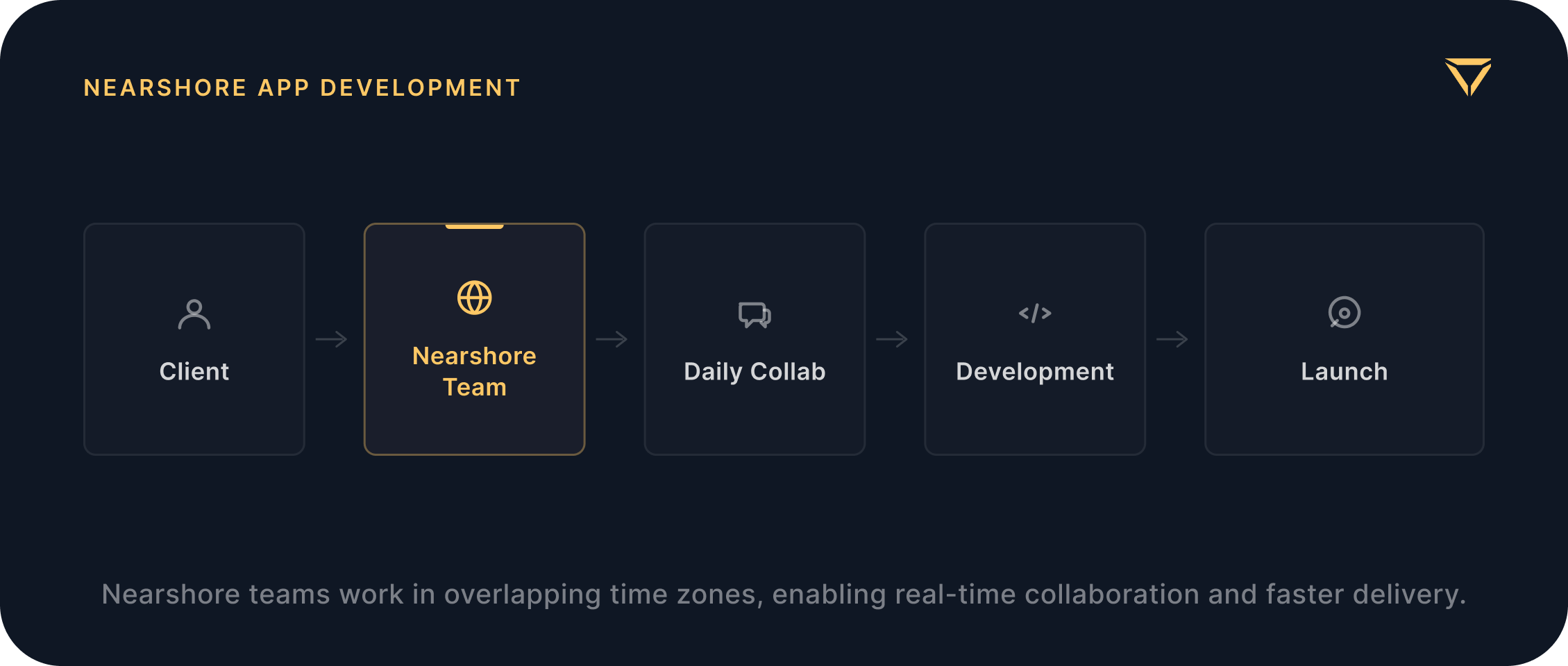
What is nearshore development in a practical context? A full-fledged nearshore app development team needed for a successful release typically includes:
- Developers (Mobile & Web): engineers who write clean and scalable code, for example, using the MERN stack or React Native.
- UI/UX Designers: specialists who design intuitive user experiences.
- QA Engineers: testers who ensure product stability before release.
- Project Managers (PM): the professional who synchronizes the client's business goals with the technical process in real time.
By choosing this approach, you essentially get an extension of your in-house team that works at your pace.
Onshore vs. Nearshore vs. Offshore: What's the Difference?
To make an informed decision, you need to clearly understand the boundaries between the three main models. This table is your primary reference point when answering the question of nearshore vs. offshore vs. onshore.
| Feature | Onshore (Local) | Nearshore | Offshore |
| Definition | Hiring a team in your country or city. | Development in a neighboring region/country. | Delegation of development to a distant country (often situated on another continent). |
| Distance | 0 – 500 km | 1,000 – 3,000 km | 5,000+ km |
| Timezone overlap | 100% of the workday (8 hours) | 1 – 6 hours (full or partial synchronization) | 0 – 3 hours (work while you sleep) |
| Hourly rate | High ~ $100 – $200+ | Average ~ $40–$80 | Low ~ $20–$40 |
| Communication | Barrier-free Native | High level of understandingFluent English, similar mentality | Often difficult Cultural gap, delayed responses |
| Best for | Strict compliance (defense, gov), unlimited budgets. | Mobile/web apps, Agile projects, team scaling. | Simple tasks with a fixed scope and low-budget support. |
When comparing nearshore vs. offshore, it's important to determine the response time. For product development, where requirements can change weekly, time zone synchronization becomes an essential success factor.
Key Benefits of Nearshore App Development
Why do more companies rely on the benefits of nearshore outsourcing? Let’s highlight six key advantages, confirmed by real-world tech businesses in 2026:
- Timezone overlap (4-9 hours per workday). Your team and developers work in sync. You can conduct daily scrums, demo sessions, and brainstorming sessions in real time, rather than exchanging emails with a 24-hour delay.
- Cost savings (30-60% of the local budget). According to comparative IT outsourcing analytics, the nearshore software development benefits are obvious compared with hiring a team in New York or London. They allow you to reduce your budget by 30-60%. You get a Senior engineer at the price of a local Junior developer, without sacrificing architectural quality.
- Cultural alignment & English proficiency. Engineers from nearshore regions are deeply integrated into Western business culture. A high level of English ensures your product vision is understood correctly, without lengthy explanations of basic concepts.
- Time-to-market (2-3 times faster). Local search, technical interviews, counteroffers, and onboarding can take several months. According to official HR analytics from Greenhouse, the average time-to-fill for onshore technology positions is 55 days. For senior roles and leads, this process often takes 80–90 days or more. A reliable nearshore partner can assemble, integrate, and launch a ready-made team in just 1-3 weeks.
- Regulatory similarity. This factor is critical for the European market. Teams from Eastern Europe operate within the GDPR framework and use similar contract standards (NDA, IP protection) and corporate law.
- Real-time collaboration. You can debug a complex incident in production together. If a server crashes or an application goes down, you don't have to wait until the morning on another continent. The team will be available right here, right now.
Best Nearshore Regions: A Two-Perspective Guide
There is no universal "best" region for nearshore software development. The ideal choice depends directly on the location of your core business. Geography determines time zones, and cultural context determines the speed of communication. Let's look at two key perspectives for 2026.
For US Companies: Latin America (Mexico, Argentina, Colombia, Brazil)
For US startups and enterprises, Latin America has become a logical extension of their in-house teams due to the following factors:
- Full or almost full timezone overlap: 0 to 3 hours difference with key US business hubs (EST/PST).
- Comparatively low rates: $30 – $75 per hour, depending on the country and the engineer's level.
- Pros of hiring a development team from Latin America: Similar corporate culture and a vast talent pool. For example, nearshore mobile app development in Mexico and Argentina is renowned for its strong talent in React Native and Flutter. Geographic proximity makes it easy to arrange on-site meetings with key specialists.
- Potential risks and weaknesses of collaboration: English proficiency varies significantly across Latin American countries. While Argentina traditionally scores highly on the EF English Proficiency Index, the situation in other countries in the region, such as Colombia and Mexico, is much worse. When exploring nearshore Latin America, you may find that communicating with middle- and junior-level developers requires the involvement of a local Project Manager. Also, keep in mind political stability, which varies across Latin American countries.
For EU Companies: Eastern Europe (Ukraine, Poland, Romania)
For businesses from the UK and EU, Eastern Europe is an unrivaled hub for engineering excellence. Moreover, due to its exceptional price-quality ratio, this region is increasingly becoming a strategic choice for cost-conscious US companies.
- Timezone overlap: 1–2-hour difference with London and Berlin, enabling a synchronous schedule.
- Average rates: Approximately $40–$80 per hour.
- Pros of hiring a development team from Eastern Europe: Fundamental mathematical education and deep expertise. The region has a strong talent pool, and the quality of training in tech specialties. It is widely recognized for its strong engineering education. For instance, according to the Coursera Global Skills Report 2025, countries in the region traditionally hold leading positions in Europe in terms of technological skills (Technology & Data Science). Tens of thousands of senior engineers are concentrated here, their level equivalent to that of US specialists with salaries of $200K+ per year. The English proficiency of these specialists is consistently high. This can be proven by the results for Poland and Romania in the EF English Proficiency Index. Moreover, the Eastern Europe outsourcing industry operates under strict GDPR standards, which are essential for data protection.
- Risks and geopolitical context: To make the right decision, it's important to be realistic. The war in Ukraine has become a serious challenge, but the Ukrainian IT sector has demonstrated phenomenal resilience. Companies have invested in autonomous infrastructure, such as Starlink and generators. Moreover, many nearshore developers now operate from backup offices within the country or in the EU. Poland, Romania, and the Czech Republic, as members of the EU and NATO, ensure stability.
At Stubbs, we are based in Ukraine and have delivered 100+ projects to European and US clients over the past five years. We have proven in practice that effective communication and streamlined delivery processes overcome external challenges.
Curious about Eastern European nearshore for your app?
Let's discuss your project.
Region Comparison Matrix
To make your choice easier, we have created a matrix that clearly compares popular destinations for finding nearshore developers and high-level nearshore tech talent. In particular, we included the SEA region for evaluating classic offshore companies.
| Region | Latin America | Eastern Europe | Central Europe (Iberian) | SEA (Offshore) |
| Best for | US-based companies, Agile mobile/web projects | EU/UK & US companies, Complex engineering, AI/Web3 | EU enterprises, strict local compliance | Low-budget, Non-urgent tasks, fixed-price |
| Avg hourly rate | $30–$75 | $40–$80 | $50–$90 | $20–$40 |
| English level | Moderate to High | High to Very High | Very High | Moderate |
| Tech talent depth | High (Mobile, JS) | Very High (Full-stack, MERN) | Moderate to High | Massive, varies in quality |
| IP protection | Moderate | High (GDPR native) | Very High (EU law) | Low to Moderate |
| Timezone (vs US/EU) | 0–3h (US) / 5–8h (EU) | 6–9h (US) / 1–2h (EU) | 6–9h (US) / 0–1h (EU) | 10–13 hours (US) / 6–7 hours (EU) |
Engagement Models in Nearshore App Development
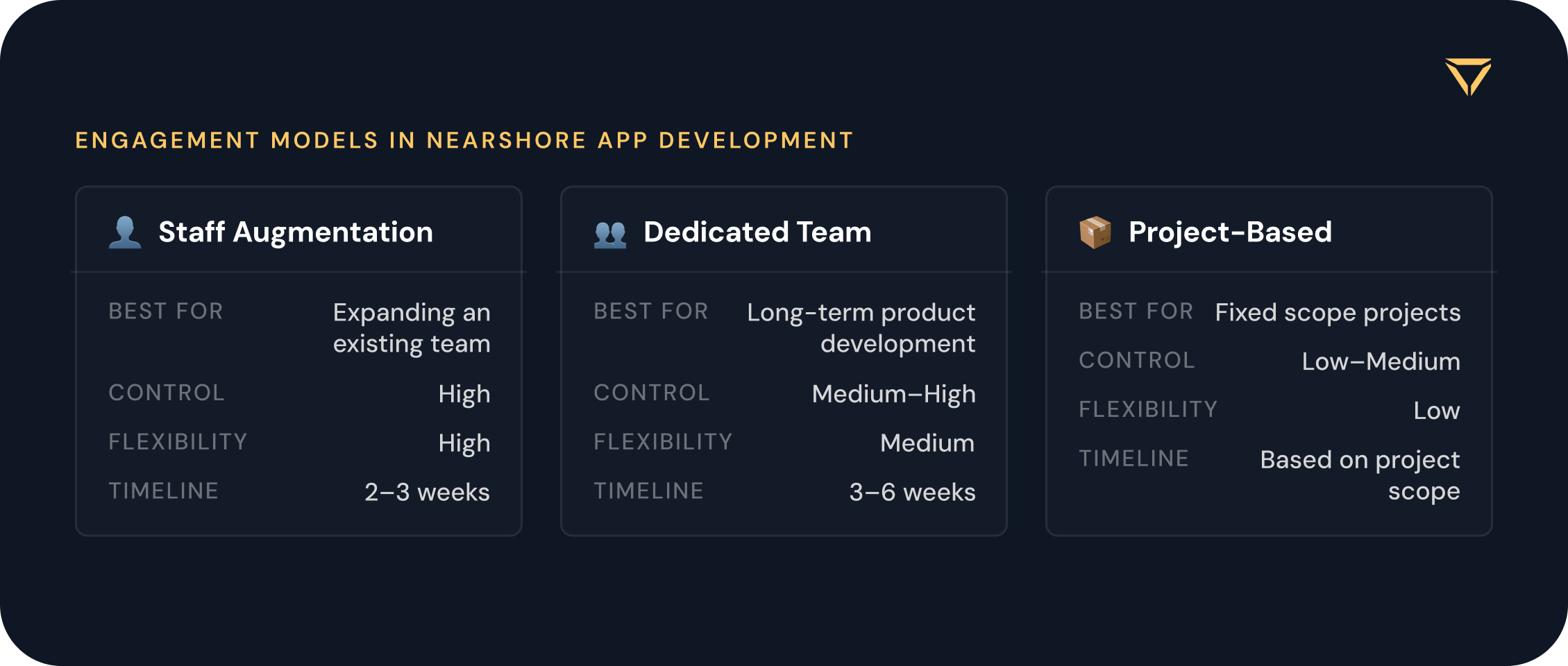
Finding the ideal region is only half the battle when implementing the outsourcing strategy. To ensure your nearshore team works as efficiently as possible, you need to choose the right engagement model. In mobile and web app development, three formats have gained widespread adoption:
- Staff Augmentation. This model is effective if you already have a fully staffed in-house team and well-established Agile processes. However, you might lack additional hands-on resources or specialized expertise, for example, a senior React Native developer. You hire nearshore staff augmentation specialists who fully integrate into your schedule, report to your management or our CTO as a service, and work as full-time employees. When to choose staff augmentation: Add nearshore specialists to your team if you have tight deadlines, need rapid scaling, and require strict control over the architecture on your side. For more details, see our Staff Augmentation page.
- Dedicated Team. If you have a product and a budget but don't have an in-house technical team, this is the proper format for you. You get an autonomous, cross-functional team that includes a Project Manager, developers, QA, and designers. It covers the entire development cycle. Process management is handled by a nearshore partner, but you retain full strategic control over the backlog. When to choose a dedicated team: This model is suitable for building an app from scratch, scaling an MVP, and implementing long-term projects without a rigid, finalized specification. How we build such teams is described in the Dedicated Team section.
- Project-Based (Fixed Scope / Fixed Price). This is a classic model in which the budget, deadlines, and scope of work are firmly set in the contract before work begins. Unfortunately, this model is ill-suited for modern app development, as it deprives the process of flexibility.
When to choose a project-based model: This hiring model is suitable for small projects with transparent, fixed requirements. For example, it will be effective if you need to integrate a specific third-party API or create a simple administrative dashboard.
Once you have decided which model you need, you can move on to the most pragmatic issue: money. Then we will provide a detailed analysis to help you understand whether nearshore is right for your business.
Nearshore App Development Cost: A Realistic Breakdown
When it comes to budget, many vendors try to hide the real numbers behind the phrase "it depends on numerous factors." Still, the basic pricing formula is very simple: Cost = Hours × Hourly Rate × Team Size.
However, to estimate the nearshore app development cost for your project, you need to consider the app's type and complexity. Based on our experience developing mobile and web products, we can distinguish three realistic price ranges:
- Simple MVP ($30,000 – $80,000). This type of digital product has basic functionality, one or two user types, standard integrations (e.g., Stripe for payments), and a clean but simple UI. Developing an MVP is a great way to test a hypothesis in 2-4 months.
- Medium Complexity ($80,000 – $200,000). This is a full-fledged app with custom animations, complex business logic, third-party API integration, a role model, and data caching. Its development takes 4-8 months.
- Complex / Enterprise app (from $200,000+). Such an app has a high-load architecture, video streaming, machine learning, strict compliance (HIPAA, banking standards), and deep integration into internal systems.
How do these figures compare to other models? The total nearshore development cost can be reduced by up to 60% without worsening architectural quality. This figure is confirmed by the Accelerance Global Software Development Rates Guide. It compares the average nearshore development bill ($60–$80/hour) with local rates in the US ($150–$200+/hour). For example, offshore teams from Southeast Asia can cost 30–50% less than nearshore teams at a base rate. However, according to the Deloitte Global Outsourcing Survey, these initial "savings" are often offset by hidden costs. Also, it is important to consider the costs of code rewrites and missed deadlines due to asynchronous communication issues.
Let’s compare average hourly rates for a Senior engineer:
- Eastern Europe (Ukraine, Poland): $40 - $80
- Latin America (Mexico, Argentina): $30 - $75
- Central / Southern Europe (Portugal): $50 - $90
- US / Western Europe: $100 - $200+
Get a transparent cost estimate for your nearshore app project.
Share your requirements, and we’ll review the scope, timeline, and expected budget.
Do You Actually Need Nearshore? A Decision Framework
Most articles about nearshore outsourcing try to sell you on services right away. At Stubbs, we believe in transparent partnerships. Nearshore is a great tool, but not every business needs it. To understand whether this model is optimal for your current stage, answer 5 key questions:
- Is the local talent market overheated? Possibly, you are spending months filling a Middle/Senior developer vacancy, but candidates are leaving with offers you can't beat.
- Are onshore hiring budgets limited? Sometimes you have a clear runway, and spending $150,000 per year on a single engineer in Denver or London will significantly cut your startup's lifespan.
- Do you need expertise you don't have on hand? For example, you may be looking for a well-coordinated MERN team or highly specialized React Native specialists, but the local talent pool is limited.
- Is real-time collaboration critical to you? Some businesses are building product startups in which the UX designer, developer, and PM should discuss features daily rather than exchanging emails once a day.
- Do you plan to work with your team long-term? Some companies are looking for a technology partner for long-term cooperation through nearshore IT services, not just freelancers to complete a one-time task.
How to interpret the results:
If you answered "Yes" to 3 or more questions, the Nearshore model will be a powerful catalyst for your business's growth. You will gain the necessary timezone overlap and save money. If your key priorities are maximum government-grade data security and having an engineer physically present in the office, you need Onshore.
If you answered "No" to most questions, and your main and only goal is to deliver something cheap and not urgent, a classic, low-cost Offshore approach will do the trick. For example, this approach is suitable for building a landing page for your website.
How to Choose a Nearshore App Development Partner
Choosing the right nearshore software development company is important for the success of your release. To mitigate risks, we recommend using this checklist for the evaluation of a potential vendor:
- Technical fit: Ensure the company has deep expertise in your stack, for example, MERN or React Native, and experience building your specific type of app.
- Portfolio + case studies: Ask for real stories of overcoming technical challenges, not just pretty pictures.
- Communication & English level: Have a call with the team. Fluent English is a basic requirement for providing high-quality nearshore software development services.
- IP protection & NDA framework: Check the legal framework. Who will own the code? How is your data protected? Here, Eastern Europe, with its GDPR compliance, has a strong advantage over other regions.
- Trial period: Is the partner willing to offer a short trial period in the form of a short engagement before signing a long-term contract?
- Reviews: Study independent reviews on platforms like Clutch or GoodFirms.
- Cultural alignment: How proactive is the team? Do they suggest improvements or simply blindly follow the specifications?
- Red flags: Avoid companies with high turnover and those that refuse to offer you the opportunity to interview developers in person before launching your project. You can find more insights on this topic in our article on choosing a technical partner.
Real-World Examples: Nearshore Success Stories
Theory works best when it's backed by practice. Many global products were built thanks to competent nearshore software development.
- Skype: The core technology and original peer-to-peer software of the iconic messenger were created by a team of Estonian engineers, including Ahti Heinla, Priit Kasesalu, and Jaan Tallinn.
- Revolut: The UK-based fintech giant relies heavily on Eastern European tech talent. It established large engineering and R&D hubs in Poland and Romania to build and scale its global infrastructure.
- Ring: Before its $1 billion acquisition by Amazon, the US-based smart home startup built a massive R&D center in Kyiv, Ukraine. It involved local engineering talent to develop its core software and computer vision technologies.
You can also explore Flymingo as a case study from our experience. It's an Uber-like app designed for charter flight pilots and travelers to and from the Bahamas. This large-scale project demonstrates how a startup can build a complex mobile-first product with a team from Eastern Europe. We handled all technical implementation, ensuring seamless integration and fast time-to-market. Here you can explore this Flymingo case study in detail.
Conclusion
The nearshore app development model in 2026 is not just a way to cut a project’s costs. It is a strategic scaling tool that offers you the perfect balance between development costs and comfortable real-time collaboration.
The choice of region depends on the location of your headquarters. For US companies, Latin America remains a logical and convenient choice. Eastern Europe has long been the great hub for EU businesses and a true hidden gem for US companies seeking top-notch quality. This region offers an unparalleled level of engineering talent and reasonable rates for businesses of all scales.
FAQs
1. What is nearshore app development?
What is nearshore app development?
Nearshore app development is the process of delegating the development of mobile or web applications to a technical team located in a neighboring country. The key difference from traditional offshore development is the minimal time zone difference, allowing teams to communicate and solve problems in real time. The timezone overlap for nearshore app development may vary from 1 to 6 hours.
2. How much does nearshore app development cost?
How much does nearshore app development cost?
App development costs range from $30 to $80 per hour, depending on the region and the engineers' skill level. A typical simple MVP will cost roughly $30,000 to $80,000. A moderately complex app will require a budget of $80,000 to $200,000. Depending on your local market, this approach can reduce overall development costs by up to 50%.
3. What's the difference between nearshore and offshore?
What's the difference between nearshore and offshore?
The main difference is time zones and cultural context. Nearshore offers overlapping working hours (1-6 hours) and a similar business culture. When choosing offshore, you often have to deal with a time difference of 8-12+ hours. This may require asynchronous communication, which significantly slows the development of dynamic applications.
4. Where are the best nearshore destinations for app development?
Where are the best nearshore destinations for app development?
For US companies, the best locations are traditionally considered to be Mexico, Argentina, Colombia, and Brazil. For businesses in the UK and EU, as well as US companies seeking complex technical expertise, Eastern Europe is the optimal choice. For example, it could be Ukraine, Poland, Romania, and the countries of the Iberian Peninsula.
5. Is nearshore better than offshore for mobile apps?
Is nearshore better than offshore for mobile apps?
Yes, for mobile apps, nearshore is a rational choice. Mobile development requires constant UX iterations, device testing, and frequent releases. This makes timezone overlap and synchronous communication very important. Offshore is better suited to stable enterprise projects with strict, unchanging technical specifications.
6. How long does it take to onboard a nearshore team?
How long does it take to onboard a nearshore team?
With onshore hiring, you may need 2-3 months for search, interviews, and a notice period. A well-coordinated nearshore team can be assembled and ready for the first sprint in just 1-3 weeks from the first call.
7. Is Eastern Europe a safe nearshore destination right now?
Is Eastern Europe a safe nearshore destination right now?
Yes. Despite geopolitical challenges, Ukraine's IT sector has demonstrated incredible resilience and continues to consistently deliver projects thanks to its autonomous infrastructure. Furthermore, countries in the region such as Poland, Romania, and the Czech Republic are members of the EU and NATO. This ensures absolute stability and data protection in accordance with GDPR standards. Many Ukrainian companies also have backup development centers in the EU.
Aug. 03, 2026
13 min to read