View all
Web DevelopmentMobile Development UX/UI DesignStaff Augmentation CTO as a ServiceDedicated TeamLow-Code DevelopmentHow Long Does It Take To Develop A Mobile App? A Stage-by-Stage Breakdown
Technology

Jun. 26, 2026
15 min to read

Table of Contents
App Development Timeline: The Short Answer
App Development Time by Stage
Timeline by App Type and Complexity
Key Factors That Affect Development Time
Native vs. Cross-Platform: How It Changes the Timeline
How to Speed Up Mobile App Development
Common Mistakes That Delay App Development
How Timeline Connects to Cost
Conclusion
How long does it take to develop a mobile app? On average, you should expect 3 to 9 months, depending on your project's complexity.
Unrealistic expectations regarding timelines are a primary reason mobile app projects run over budget, fail to meet investor milestones, or collapse before launch. If you are a startup founder, Chief Technology Officer (CTO), or Product Manager in the early planning stages, you need accurate, data-backed estimates. This will help you to build the product roadmap, secure venture capital funding, and coordinate your marketing efforts.
As we move through 2026, mobile technologies continue to introduce new opportunities for businesses. However, changing requirements and unclear initial scope are among the main reasons for delayed timelines and budget overruns. According to GoodFirms' research on mobile app development, these challenges are often cited by top development teams.
This comprehensive guide provides a realistic, stage-by-stage breakdown of the mobile app development process. You will learn exactly how long each phase takes and how specific app features and industry compliance requirements impact your schedule. Also, you will discover proven strategies to speed up your time-to-market without sacrificing architectural quality.
App Development Timeline: The Short Answer
When mapping out your app development timeline, the first question is usually how long to build an app from scratch. The average time to develop an app is directly tied to its feature set, custom elements, backend architecture, and overall project complexity. Based on extensive development data and industry benchmarks from platforms like Upwork, mobile applications generally fall into one of three complexity tiers.
Here is a high-level overview of what to expect:
| App Complexity | Average Timeline | What It Includes | Examples |
| Simple | 2 – 4 months | 5 – 7 screens, standard UI components, no complex backend, 1 platform, basic user authentication, simple local databases. | Simple calculators, basic to-do lists, standard informational apps, and simple event schedules. |
| Medium | 4 – 6 months | Custom UI/UX, third-party API integrations, payment gateways (Stripe/PayPal), basic backend infrastructure, user roles, and real-time chat. | E-commerce storefronts, food delivery apps, booking applications, and standard employee management tools. |
| Complex | 6 – 12+ months | Highly custom micro-animations, real-time data synchronization, microservices architecture, high security, multi-language support. | Comprehensive fintech apps, enterprise SaaS platforms, heavy social media platforms, and telemedicine portals. |
Understanding where your product fits within these tiers is the first step in creating a realistic budget and timeline. An app may seem simple on the surface because it has a clean, single-screen interface, as with flight-booking apps. But in reality, it might actually require a complex backend to aggregate real-time data from dozens of airlines simultaneously.
App Development Time by Stage
A professional mobile app development process is divided into distinct, sequential phases. Rushing through one phase inevitably causes bottlenecks in the next. Here is a deep dive into the stages of app development. We will detail how the timeline breaks down across all app development phases.
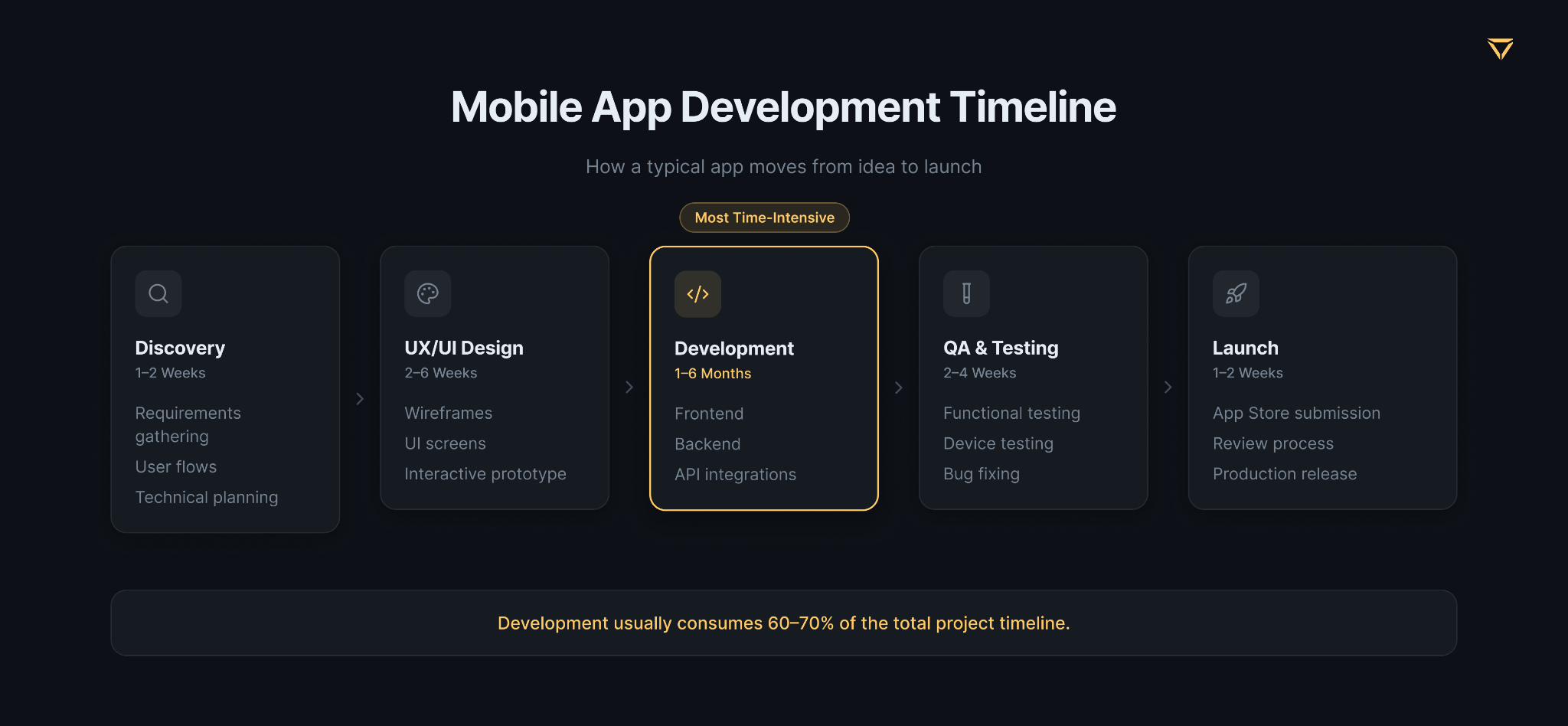
Discovery & Requirements (1 – 2 weeks)
Before developers start coding, you need a clear, actionable roadmap. The discovery phase is the foundation of the entire app development process. During this 1 to 2-week period, business analysts, product managers, and lead architects collaborate to define the project scope. They create detailed user personas, map out the user journey, and select the right tech stack. Depending on the process, teams may produce an SRS, PRD, backlog, or technical specification.
This phase takes approximately 1 to 2 weeks because you must carefully assess business goals through the technical feasibility lens. Do not skip this step. A poorly executed discovery phase may lead to scope creep. This can delay your project by months and drain your budget. A firm foundation allows every engineer and designer to focus on the product's core objectives.
UX/UI Design (2 – 6 weeks)
The design team starts mapping out the visual and functional user journey as soon as the basic requirements are set. This process typically moves through several iterations. It starts with low-fidelity wireframes, evolves into high-fidelity mockups, and finally results in interactive, clickable prototypes. A high-quality, clickable prototype reduces app development time. It clarifies functionality, transitions, and user flow for the engineering team. This phase should leave no room for ambiguity and misunderstanding.
Good design is iterative and requires constant feedback loops. Mobile apps for specialized niches like fintech or healthcare may require slightly more time for this phase due to strict accessibility standards such as the latest WCAG 2.2 guidelines. Also, developers should consider compliance requirements that dictate how sensitive data must be displayed. In our approach to UX/UI design, we consider these and other guidelines to create an intuitive and compliant interface.
A well-researched design process directly impacts delivery speed. For example, when designing Wicked Tennis, we conducted thorough UX research to understand the match-scheduling challenges of Boston tennis players. By focusing on a minimalist, mobile-first interface for quick scheduling, our 6-member team successfully designed and developed the platform in exactly 6 months, attracting over 400 users within two months of release.
Development & Coding (1 – 6 months)
This is the longest, most resource-intensive, and most critical phase. It consists of implementing designs of mobile frontend interfaces, setting up backend architecture, and integrating with third-party APIs. The total mobile app development time is determined by the sheer volume of the app’s logic. Professional teams use an Agile, sprint-based approach. It typically divides work into two-week cycles. This allows for regular check-ins and continuous integration.
Development speed depends on the backend's complexity. Building a custom architecture that can scale to a million users takes exponentially longer than using a BaaS (Backend-as-a-Service) solution. The size and seniority of your engineering team significantly influence the development speed. A highly experienced team with 5+ years of expertise in React and Node.js can significantly cut the dev phase compared to junior developers. This result is achieved by avoiding common architectural dead-ends.
QA & Testing (2 – 4 weeks)
Quality Assurance is one of the most critical app development stages. That is why it should not be sacrificed for the sake of speed. Modern users have zero tolerance for crashes, slow load times, or broken UI elements. The testing phase involves a rigorous mix of manual testing, automated scripts, device fragmentation testing, security penetration testing, and regression testing. In particular, device fragmentation testing ensures the app looks good on an iPhone 15, an older iPad, and various Android devices with different screen sizes. Regression testing verifies that the new code hasn't broken existing features.
Uncovering edge-case bugs requires systematic probing. Still, modern development teams mitigate this by integrating QA parallel to the development phase. By running automated tests alongside daily code commits, teams save weeks of time at the end of the project. Fixing a bug during active development is significantly faster than unpicking a completed, compiled architecture to fix a foundational flaw.
Launch & Post-Launch (1 – 2 weeks + ongoing)
Submitting your application to the Apple App Store or Google Play Store is the final step in your app development timeline. You must prepare promotional assets, write compliant descriptions, and configure privacy policies. Only after that can you submit the binary for review.
Based on official developer guidelines, Apple states that 90% of apps are reviewed in under 24 hours. From our practice, we recommend budgeting 1 to 3 days for a first-time submission. Google Play app reviews can take anywhere from a few hours to 7 days, depending on your developer account standing. Your first release will often take the longest as the stores perform a deep dive into your app's privacy practices and code security.
Store rejections are common for minor infractions, such as missing metadata or unclear privacy policy links. These mistakes require resubmission and a reset of the clock.
The launch of the app is not the end of the project’s lifecycle. Post-launch involves monitoring app performance via analytics and rolling out hotfixes for unforeseen bugs. Possibly, you will optimize server performance and plan the next release based on real user feedback.
Timeline by App Type and Complexity
Founders often ask, "How long does it take to make an app in my specific industry?" Various industries demand fundamentally distinct software architectures. A simple fitness tracker requires a vastly different approach from that of a HIPAA-compliant medical portal. To help you plan your mobile app development timeline accurately, use the table below as a baseline. Please note that these are illustrative ranges based on typical industry experience. Real-world situations depend on numerous factors, including your features and the complexity of API integration. Use these estimates to form your initial expectations, but keep in mind that precise timing can be done after a technical discovery phase.
| App Type | MVP (Months) | Standard (Months) | Complex (Months) |
| E-commerce | 2 – 3 | 4 – 5 | 6 – 8+ |
| Fintech | 3 – 4 | 5 – 7 | 8 – 12+ |
| Healthcare | 3 – 4 | 5 – 6 | 7 – 10+ |
| Fitness | 2 – 3 | 4 – 5 | 6 – 8+ |
| Social Network | 3 – 4 | 5 – 7 | 9 – 12+ |
| SaaS Mobile App | 2 – 3 | 4 – 6 | 7 – 9+ |
| Marketplace | 3 – 4 | 5 – 7 | 8 – 10+ |
Deep Dive into Industry Timelines
- E-commerce (4 – 8+ months): Of course, basic shop templates exist. Still, custom e-commerce apps need rigorous product catalog management and advanced filtering algorithms. Developers should make secure payment gateway integrations and synchronize inventory with existing ERP systems. Also, you can attract customers with AR product try-ons and AI-powered personalized recommendations.
- Fintech (5 – 12+ months): Fintech development is quite challenging due to the demanding security architecture. Even an MVP requires bank-grade encryption, secure user identity verification (KYC/AML), and two-factor authentication (2FA). Also, it should comply with different financial regulations, such as PCI DSS. Integrating with legacy banking APIs often causes timeline extensions.
- Healthcare (5 – 10+ months): Healthcare apps deal with highly sensitive data. That is why telemedicine apps or patient portals must comply with HIPAA (US) or GDPR (EU), which extend testing requirements. Advanced features include secure video conferencing, integration with wearable health devices, and interoperability with Electronic Health Records (EHRs).
- Fitness & Wellness (4 – 8+ months): A standard fitness app includes video libraries and workout tracking. For instance, our 4-member team built Ontrack, an intuitive weight-tracking platform, in 5 months. We developed an adaptive dashboard that provides insights into caloric deficits. This app has custom timeline predictions that help users reach their goals. Advanced fitness apps may delve deeper into IoT integrations. They are connecting to smartwatches and heart rate monitors.
- Social Networks & Marketplaces (5 – 12+ months): The core challenge here is scalability. A social app must handle massive, simultaneous database reads and writes. Marketplaces require dual interfaces (buyers and sellers), effectively doubling the development effort. As a real-world example, building the complex two-sided aviation marketplace Flymingo took our 6-member team 10 months. Using React Native and Node.js, we created a comprehensive platform that connects charter pilots with passengers and requires intricate logic for aircraft weight calculations and flexible split payments.
Want a realistic timeline tailored specifically for your app's unique requirements?
Let's discuss your project scope.
Key Factors That Affect Development Time
Why do some applications launch seamlessly in three months while others drag on for over a year? Your app development time depends on a specific set of technical factors integrated into your app development process:
- Feature Complexity: Features offered in the app are essential for the duration of the app’s development. Simple features such as email registration, standard text lists, or static content pages take hours to implement. Complex features such as real-time multi-user video streaming, offline synchronization, or custom AR require weeks of specialized R&D.
- Platform Choice (iOS vs. Android vs. Both): Building an app for a single platform is the fastest route. However, most modern businesses need to reach both Apple and Android users. Developing two separate native apps increases the timeline, whereas a cross-platform approach shortens it.
- Team Size and Seniority: Involving more developers in your project doesn't always make the development faster. A well-balanced team of senior developers writes cleaner code faster. It chooses proven design patterns and anticipates architectural bottlenecks before they happen. Junior developers may write code quickly, but often require extensive code review, revisions, and refactoring later on.
- Third-Party Integrations: Rarely does an app exist in isolation. You will likely need to integrate external services. Integrating well-documented APIs such as Stripe or Twilio is fast. Connecting to legacy enterprise software or poorly documented third-party APIs adds unpredictable delays. In these cases, developers need to build custom middleware.
- Design Complexity: Using standard native UI guidelines accelerates development by enabling developers to use prebuilt components. Implementing highly custom micro-animations, non-standard navigation gestures, and complex 3D graphical elements requires highly specialized frontend work.
- Regulatory Compliance: Compliance with HIPAA, PCI DSS, GDPR, or CCPA requires providing strong security measures. Developers need to integrate the newest encryption, strict data retention policies, and comprehensive audit logs. All these measures also extend the development and testing phases.
- Scope Changes: Changing requirements mid-development is the number one killer of deadlines. Deciding to add a "quick chat feature" midway through development often requires tearing down the existing database structure and rebuilding it. Treat your agreed-upon scope as a fixed contract for the first version.
Considering building a web version alongside your mobile application? Explore our web application development expertise to see how we align dual timelines for simultaneous multi-platform launches.
Native vs. Cross-Platform: How It Changes the Timeline
One of the most important decisions affecting your mobile app development timeline is choosing between native and cross-platform frameworks. This single decision impacts both your schedule and your budget.
- Native Development (Swift for iOS, Kotlin for Android): Native development means writing code specifically for the operating system on which it will run. If you want your app on both the App Store and Google Play, you must maintain two entirely separate codebases. This means you need two distinct development teams. Because you are building two different apps, the app development time typically increases by 30–50%. Native is traditionally chosen when your app requires heavy graphics processing, complex background processing, or deep OS-level hardware integration.
- Cross-Platform Development (React Native, Flutter): This modern approach uses a single codebase that compiles and runs on both iOS and Android. You will write the logic once, thus significantly reducing development, testing, and future maintenance time.
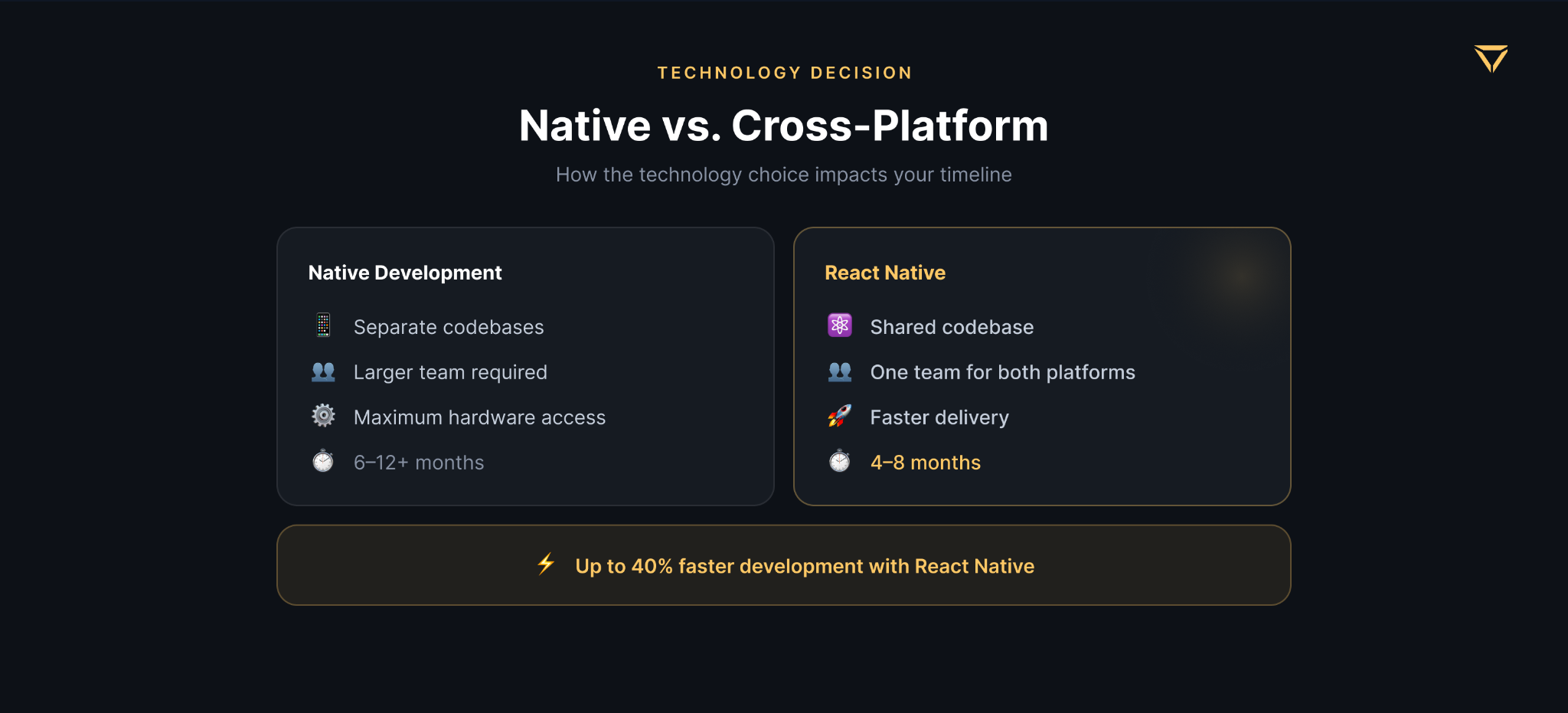
At Stubbs, we use React Native for the vast majority of our cross-platform projects. It cuts the timeline by approximately 40% compared to managing two native builds. At the same time, it does not compromise rendering speed or user experience. For most startups and enterprise tools, cross-platform development is a good choice for rapid market entry.
How to Speed Up Mobile App Development
How long does it take to build an app if you accelerate the app development process? If you are racing against strict investor deadlines and wondering about that, here are the most effective strategies to compress your timeline:
- Start with an MVP. Do not try to create an all-encompassing mobile app for your first release. Determine the core value proposition and features that address the key user problem. For example, you want to launch a ride-sharing app. In such a case, you need a map, a booking button, and payment processing. You do not need in-app games or a complex loyalty point system for the first version.
- Fix the Scope Early. Lock in your detailed requirements during discovery and fiercely resist the urge to add "just one more feature." Log new ideas in a backlog for version 2.0.
- Go Cross-Platform. Use frameworks like React Native to hit both major app stores simultaneously with a single unified engineering team.
- Use Agile Sprints. Break the project into 2-week iterations. This provides continuous delivery and keeps the team focused on immediate goals. If a technical hurdle arises, you will be able to correct the course rapidly.
- Implement Parallel QA Testing. Do not leave QA until the very end. Integrate QA engineers into the daily workflow. Test individual features as soon as they are coded. Finding a bug early is much better than finding it after three months of development.
- Leverage Ready Design Systems and BaaS. Use established UI kits to speed up frontend development. For the backend, consider BaaS platforms for standard features such as push notifications or basic authentication. However, keep in mind that a BaaS solution is not universal. Consider scalability needs, data complexity, and potential vendor lock-in when choosing the platform. The proper infrastructure allows your team to focus on business logic.
- Hire an Experienced Team. The synergy of a team that has worked together for years cannot be replicated overnight. In our experience, launching a lean MVP and iterating based on real user feedback is the most effective way to reduce time-to-market and build a product people actually want. Our work on complex projects such as Flymingo, OnTrack, and Wicked Tennis highlights how a strategic, experienced approach accelerates delivery. Additionally, if you have an in-house team but need to move faster to hit a deadline, using IT staff augmentation can provide the velocity and senior expertise you need.
Looking to speed up your app development and launch ahead of schedule?
See how Stubbs builds mobile apps.
Common Mistakes That Delay App Development
Even well-funded projects developed by real professionals can stall. Avoid these typical mistakes that prolong your app development timeline:
- Uncontrolled Scope Creep. Constantly adding new requirements forces developers to pause, re-evaluate, and often rewrite existing backend architecture.
- Vague Requirements. A lack of precise, documented user stories may lead to endless design revisions and guesswork by developers. As a result, you will end up with a final product that doesn't match your vision.
- Skipping Discovery. Diving straight into writing code without a comprehensive technical blueprint creates massive technical debt. At the end, the app may collapse as you try to scale.
- Insufficient QA Budget. Cutting testing time may lead to severe post-launch bugs, one-star store reviews, angry users, and prolonged downtime. The time spent dealing with a botched launch far exceeds the time a proper QA phase would have taken.
- Too Many Features for v1. Trying to build the perfect app with 50 features prevents you from quickly gathering real user feedback. You might build features users don't care about.
- Choosing the Wrong Tech Stack. Choosing a trendy but unsupported framework or an outdated legacy system can trap your project in a technical corner. When it's time to scale or add complex integrations, you may find your framework doesn't support them, which may require significant refactoring or migration.
How Timeline Connects to Cost
How much does it cost to develop an app? Time and budget are inextricably linked in software development. The following formula demonstrates this connection:
Time (Hours) × Number of Specialists × Hourly Rate = Total Cost.
If poor planning or scope creep extends your project by two months, your overall app development cost increases significantly. The reason is that you are paying the salaries of an entire development team for those extra 60 days.
Manage your timeline through a lean MVP approach, use a cross-platform framework, and prevent scope creep. In this case, you will reduce your financial risk. To understand budget dynamics deeper and see average market rates, read our comprehensive guide on how much it costs to develop a digital product.
Conclusion
Building a successful, scalable mobile app takes time, and there's no room for rushing it. While the 3 to 9-month average serves as a solid benchmark, a timeframe for a particular project ultimately depends on your unique business requirements, regulatory environment, and technical complexity. Here is a final summary of the expected timeframes by stage:
How long does it take to develop a mobile app?
| App Development Stage | Expected Timeframe |
| Discovery & Scope Definition | 1 – 2 Weeks |
| UX/UI Design & Prototyping | 2 – 4 Weeks |
| Development, Architecture & Coding | 1 – 6 Months |
| QA, Security & Performance Testing | Continuous (runs parallel to Dev + 1 week final regression) |
| App Store Review & Launch | 1 – 2 Weeks |
Note that the sum of these phases is not strictly sequential. In modern Agile development, some phases overlap. For instance, backend environment setup often begins during the UI design phase. QA runs in parallel with the development phase. Thanks to this overlap, a simple app can be delivered in a 2-month timeframe.
Ultimately, a precise, binding timeline can only be calculated after a thorough discovery phase. During this stage, business goals are translated into technical specifications. Don't guess your timeline — plan it.
Ready to start building?
Get a free, detailed project estimate and realistic timeline tailored to your concept.
FAQs
1. How long does it take to develop a simple mobile app?
How long does it take to develop a simple mobile app?
A simple mobile app usually takes 2 to 4 months to develop from concept to launch. This period covers the creation of a product with 5 to 7 screens, standard UI components, and basic user functionality. For example, this can be a single platform without an overloaded custom backend infrastructure.
2. Can you build an app in one month?
Can you build an app in one month?
You can try to build an MVP or a proof of concept (PoC) with limited functionality in one month. However, it is highly unlikely to create a product with a custom design, secure backend infrastructure, third-party integrations, and comprehensive QA testing.
3. What takes the most time in app development?
What takes the most time in app development?
Development and coding are the longest of all other phases. They may require from 50% to 60% of the project’s time. Creating a secure, scalable backend architecture and integrating APIs are the most time-demanding tasks. Unexpected scope changes can also extend this phase.
4. How does the choice of platform affect development time?
How does the choice of platform affect development time?
Developing two native apps for iOS and Android requires different codebases and often two teams. This choice increases the overall time by roughly 1.5x to 2x. Using cross-platform technologies allows your team to write a single codebase that deploys to both platforms. This speeds up the project.
5. How long does app store approval take in 2026?
How long does app store approval take in 2026?
Apple's App Store review may take 1 to 3 days, and Google Play review can take from a few hours to 7 days. Your first release usually takes the longest. In such a case, both stores thoroughly check the security.
6. What is an MVP and how long does it take to build one?
What is an MVP and how long does it take to build one?
An MVP is a Minimum Viable Product. It is an early version of an application. It contains only the core features that are needed to solve the user's primary problem. Building a high-quality MVP may take between 6 and 12 weeks.
7. How can I significantly reduce my app development timeline?
How can I significantly reduce my app development timeline?
To speed up development without sacrificing quality, adopt an MVP-first mindset and lock in a fixed project scope during the initial discovery phase. Use cross-platform frameworks such as React Native. Enforce parallel Quality Assurance (QA) testing throughout the development cycle rather than waiting until the end, and partner with an experienced development team.
Jun. 26, 2026
15 min to read